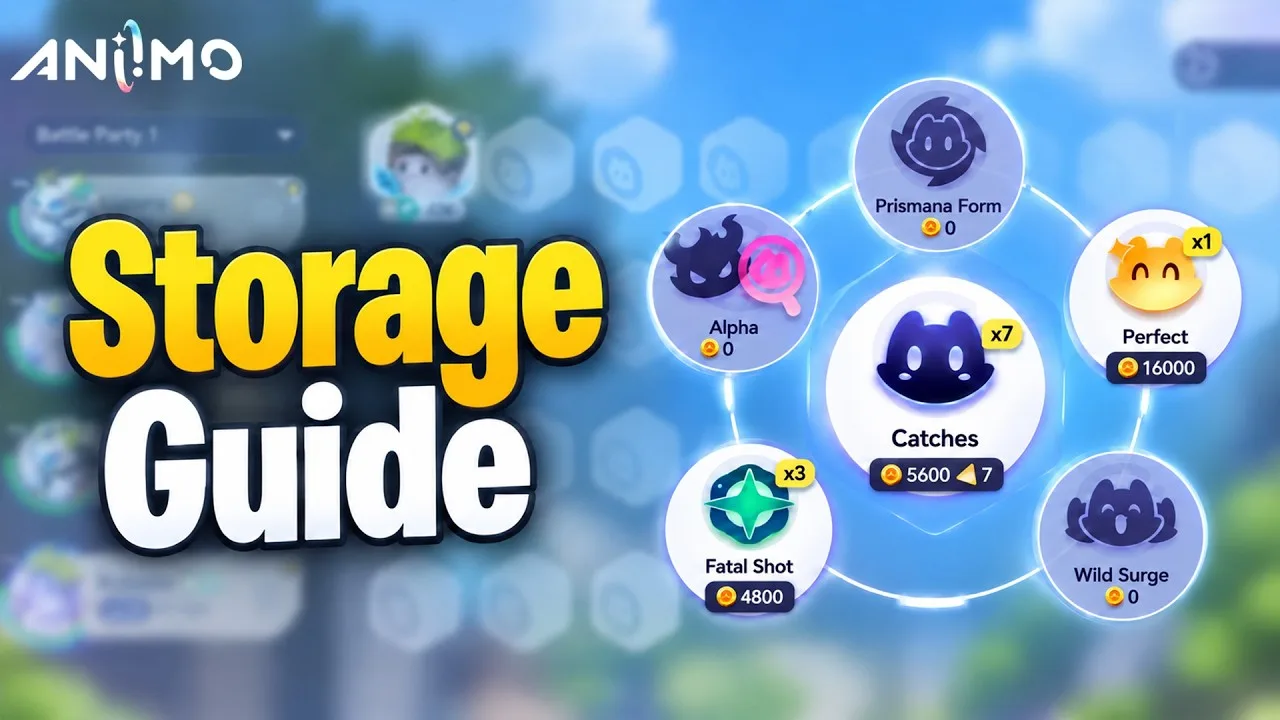
Beginner · 9 min
Which Aniimo to Keep: Potential and Personalities Explained
Every new Pathfinder hits the same wall: a box full of duplicates and no idea which ones are worth levelling. AniimoSync walked the Research Console on launch day, and we pulled the tier odds, the per-point stat maths and the full personality table out of the game’s own data files.

Written by
AniimoSync
Launch-day walkthrough, footage and the personality and affinity charts by AniimoSync
Keep every Aniimo the Research Console rates Perfect, keep Elite for creatures you actually want to play, and release Common and Good. The game’s own catch table gives an ordinary wild Aniimo a 66% chance of Common, 26% Good, 7.2% Elite and 0.8% Perfect, which puts Perfect at roughly one catch in 125.
That is the whole answer. Everything below is the reasoning: what Potential measures, where the rating screen lives, what a tier is worth in real stats, how personalities and element affinity traits stack on top, and which parts of a bad roll you can still fix later.
The walkthrough is AniimoSync’s launch-day footage, recorded in the live client on 16 September 2026, including the personality and affinity charts he puts on screen. We then checked every number against the game’s own data files for build 1.0.0.7, and each section says which line came off the screen and which came out of the tables. Where the two disagree, we say so.
What is Potential in Aniimo?
Potential is a per-stat growth number, and the Common to Perfect tier is just the grade the Research Console puts on the set. The game’s own explainer is blunt about it: Each Aniimo has its own innate potential. After you catch and report an Aniimo, it will be rated based on its total Innate Potential and recommended attributes. Ratings are divided into 4 tiers: Common, Good, Elite, and Perfect. A higher potential tier means stronger starting attributes, making that Aniimo a better choice to train.
Underneath the grade, each of the six combat stats carries its own Potential number: HP, ATK, P.DEF, REGEN, M.DEF and BREAK. The conversion table in the data files is the part worth memorising. One point of Potential in a stat is worth +4% of that stat, applied as a percentage modifier, and the same +4% applies to all six. The point ceiling per stat is 20, so a maxed stat is running at +80%.
So the tier matters, but it is a summary of six numbers, and the summary weights the attributes the creature’s role actually uses.
Where do you check an Aniimo’s Potential?
At the Research Console, the machine on the platform at any camp outpost. The in-game tip says it plainly: After catching Aniimo, head to the Research Console at an outpost for an Innate Potential Rating. There are 4 tiers: Common, Good, Elite, Perfect. Nothing about a wild Aniimo reveals its Potential before you catch it, which is exactly why AniimoSync spends the first minute of the video catching the same creatures over and over.

Uploading is safe. The scanner screen carries its own reassurance in small type: You won’t lose your Aniimo by submitting this report. What the upload does is assign the rating and pay out the report rewards.

Once reported, the grade travels with the Aniimo as a coloured banner on its card in Aniimo Management, and the box filter can narrow down to it.
What are the odds of each Potential tier?
For an ordinary wild Aniimo the split is 66% Common, 26% Good, 7.2% Elite and 0.8% Perfect. That roll is attached to the creature in the data files, and 513 of the 547 Aniimo prototypes use it, so it is the number that applies to almost everything you can walk up to and catch.
The other rolls in the same table are the interesting part, because they are what the game hands you instead when it wants to be generous.
| Source | Common | Good | Elite | Perfect |
|---|---|---|---|---|
| Ordinary wild catch | 66% | 26% | 7.2% | 0.8% |
| Prismana forms and elite spawns | 0% | 80% | 18.6% | 1.4% |
| Eggs marked “Elite potential or higher” | 0% | 0% | 95.2% | 4.8% |
| Umbral Aniimo | 0% | 0% | 0% | 100% |
The Umbral row is confirmed twice over: the table gives them a roll that can only land on Perfect, and the item text agrees, Affected by concentrated Vein energy, Innate Potential is always Perfect. Legendary Aniimo do not roll at all. Lunara, Fennelun, Helion, Soleon and Irisalis carry a fixed spread written into their prototype, so every copy starts with the same six numbers.


Two smaller things from the tables. Some areas carry a buff reading You are more likely to catch high-potential Aniimo in this area, and the rarest Aniipod in the game guarantees a Perfect Sparkling catch outright.
What does each Potential tier actually change?
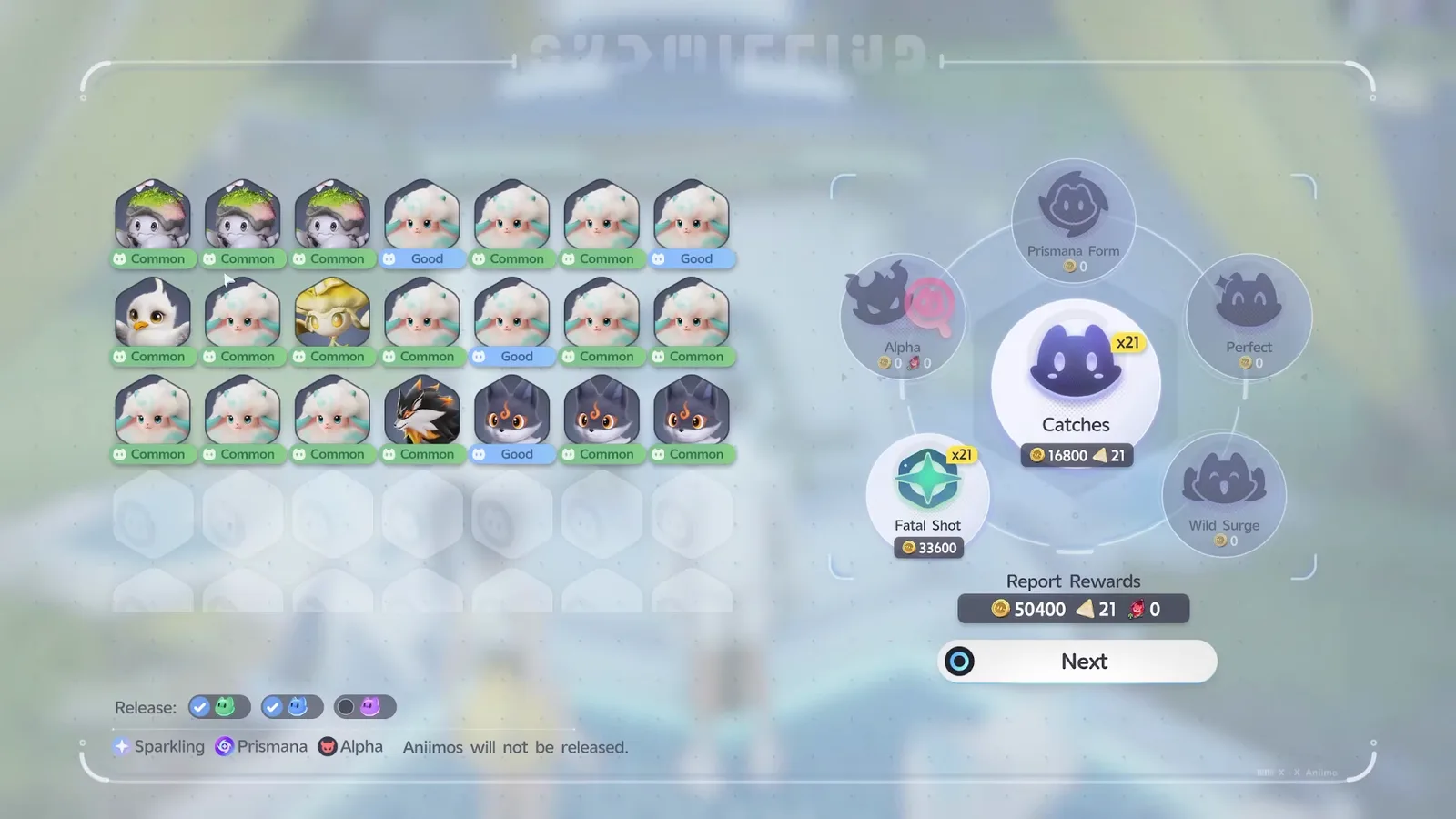
The tier itself changes nothing. The six Potential points behind it change everything, at +4% per point per stat. A higher tier means the console found more points, and found them on the stats the creature’s role wants. AniimoSync’s upload of 21 catches is a fair sample: every one came back Common or Good, and the Perfect, Alpha and Prismana counters on the report ring all read zero.
| Tier | Symbol | Worth resources? | Offered by auto release? |
|---|---|---|---|
| Common | Green | No | Yes |
| Good | Blue | Only as a stopgap | Yes |
| Elite | Purple | Yes, if you want that creature | Yes |
| Perfect | Gold | Yes, always | No |

The last column is the game telling you what it thinks. The Release row on the report screen has toggles for Common, Good and Elite only: Perfect is never offered for auto release, and the line under the toggles states that Sparkling, Prismana and Alpha Aniimo will not be released whatever the toggles say. Our storage box guide walks the rest of those protections.
Which Aniimo should you keep, and which should you release?
Keep Perfect on sight. Keep Elite on a creature you actually want in a squad. Release Common and Good unless the creature is new to your Aniidex. AniimoSync’s rule on camera is the same one and it is the right one: if there is a specific Aniimo you want, keep catching it until a better grade shows up, and do not pour materials into a Common because it is cute.
It helps to see what a grade looks like from the inside. These three are read straight off the hexagon in AniimoSync’s footage, and each number is that stat’s Potential, so each is worth four times itself as a percentage.
| Aniimo | Grade | Role | HP | ATK | P.DEF | REGEN | M.DEF | BREAK | Total |
|---|---|---|---|---|---|---|---|---|---|
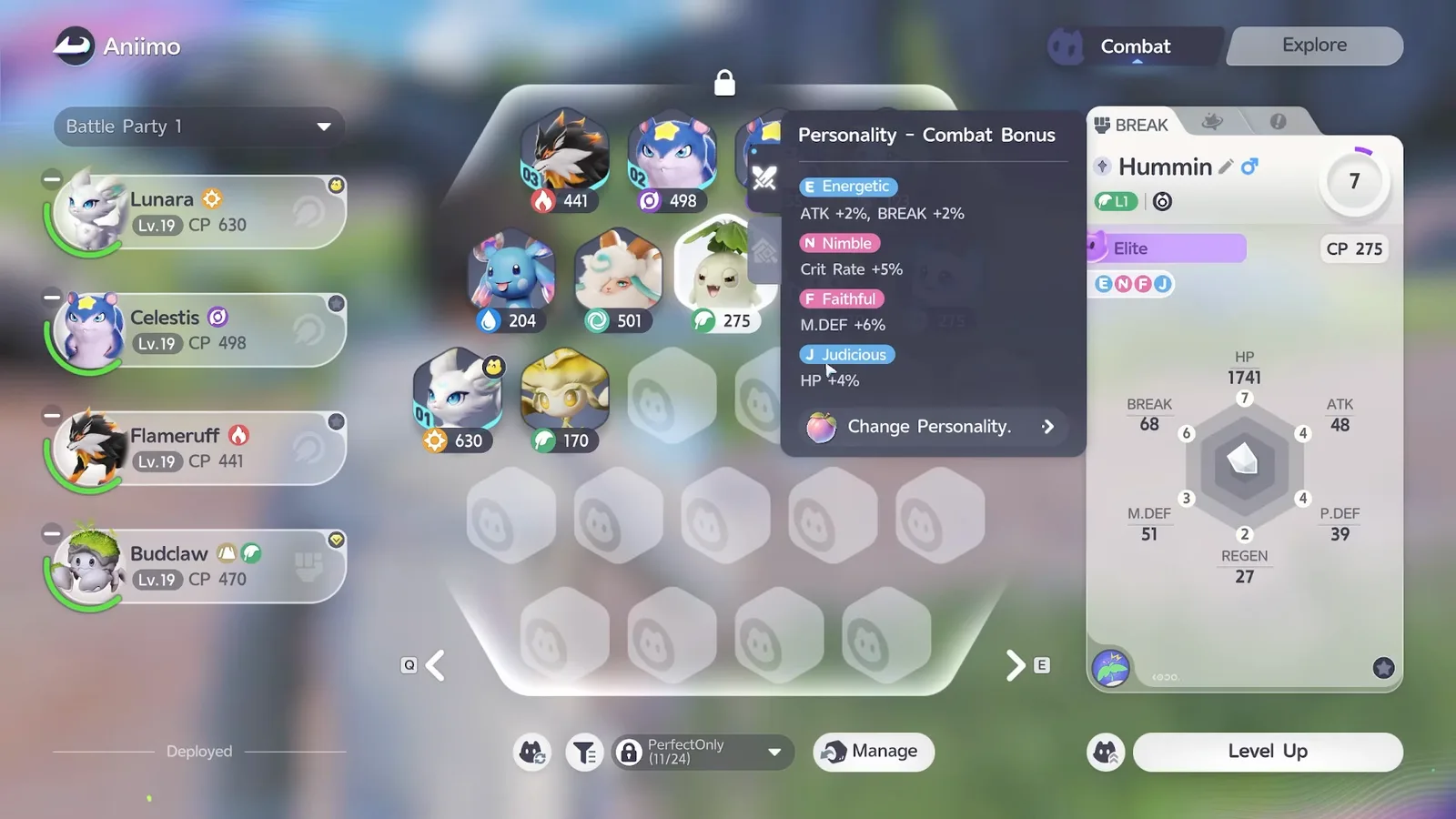
| Hummin | Elite | BREAK | 7 | 4 | 4 | 2 | 3 | 6 | 26 |
| Celestis | Perfect | DPS | 4 | 8 | 3 | 8 | 4 | 5 | 32 |
| Iris | Perfect | DPS | 5 | 8 | 5 | 8 | 4 | 2 | 32 |
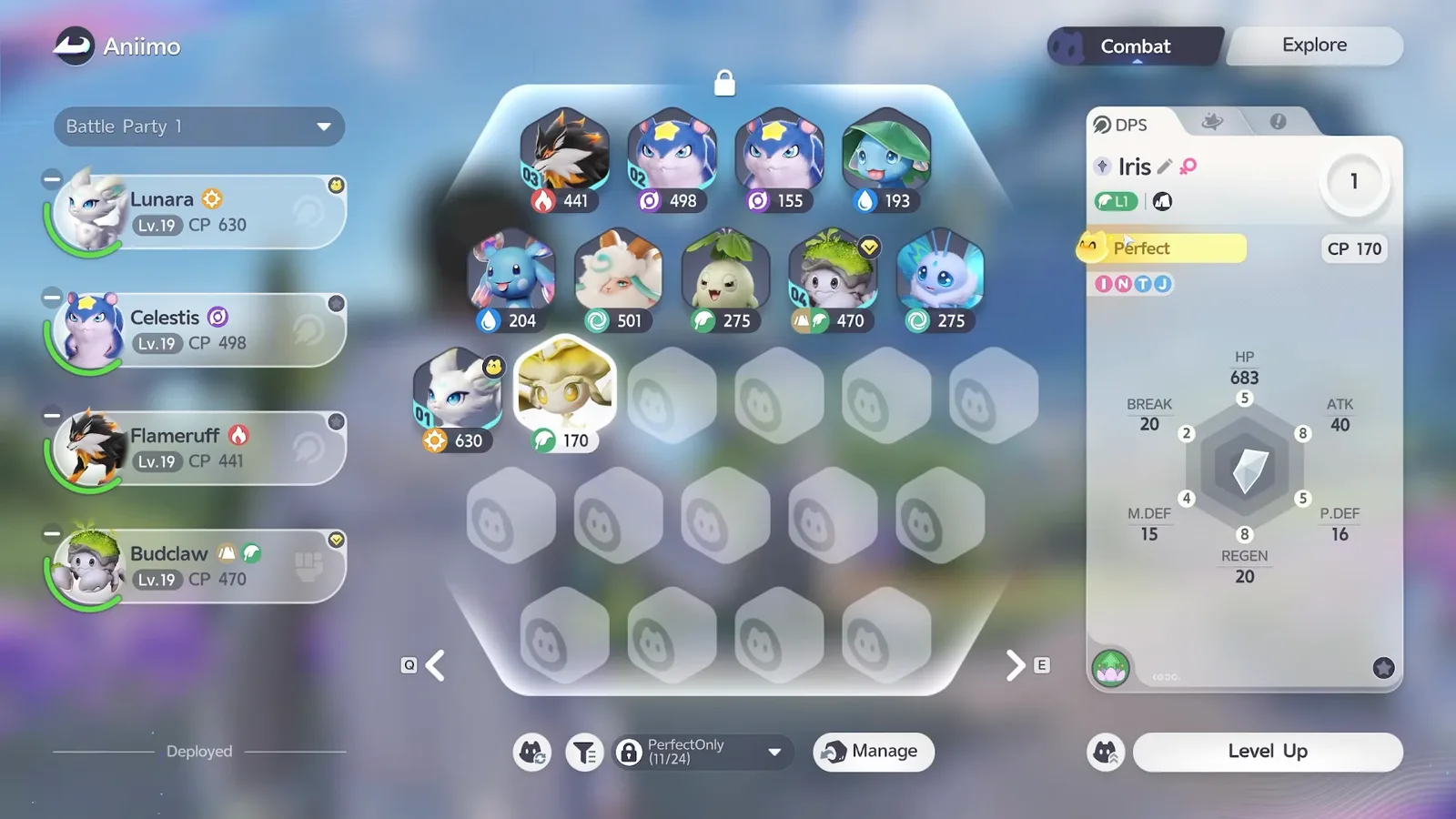
Perfect is not “every number is high”. Both Perfect creatures above carry 32 points, and in both cases the two 8s sit on ATK and REGEN, the stats a DPS wants. The Elite Hummin has a lower total but its best numbers, 7 on HP and 6 on BREAK, are on the stats a BREAK unit uses. That is the “recommended attributes” half of the rating doing its work, and it is why an Elite that fits its role is a perfectly good squad member while you keep hunting.
Keep the first copy of anything new regardless of grade: Aniidex entries and research rewards do not care about Potential.
How do personalities work, and which stats do they change?
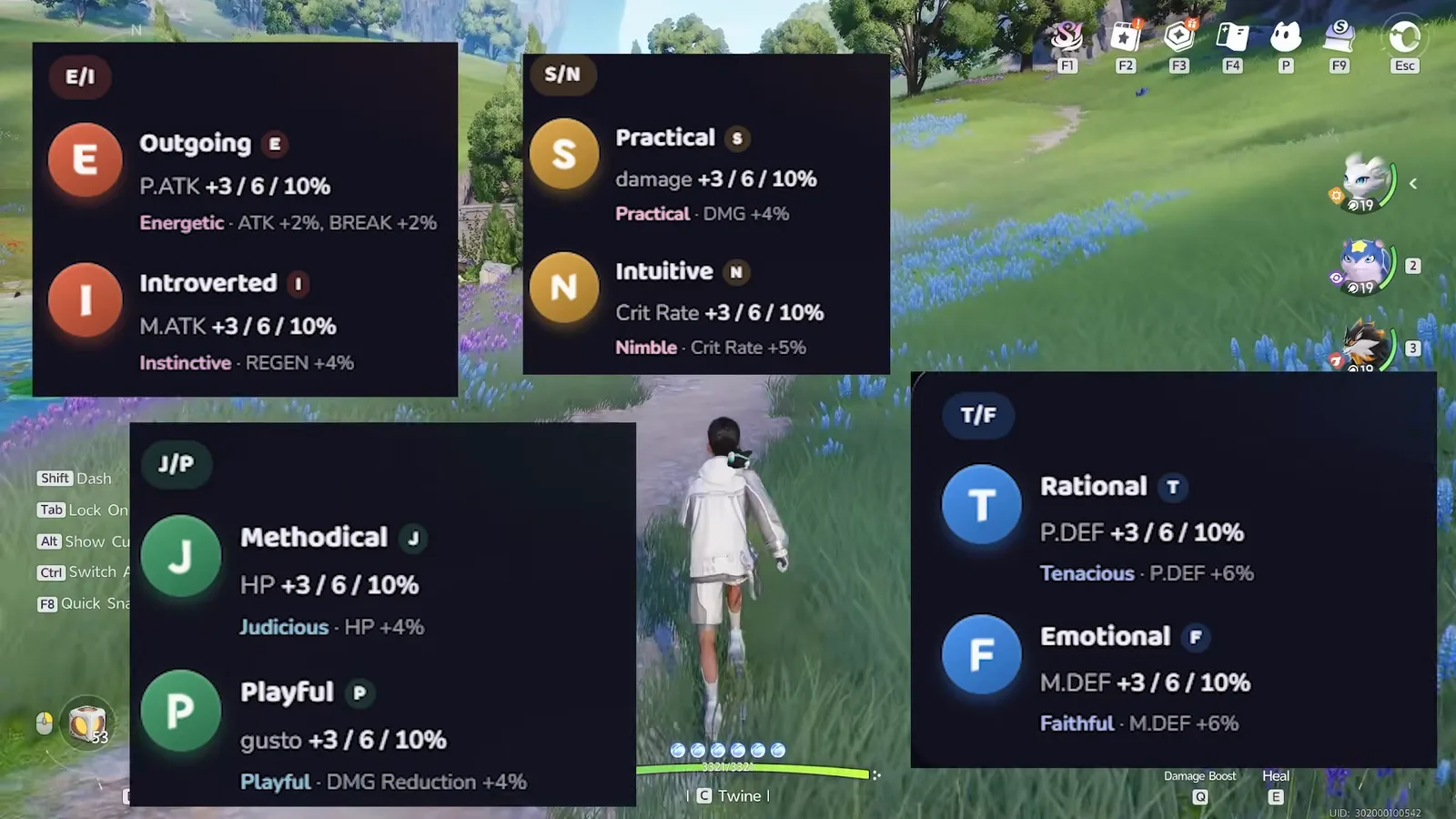
Every Aniimo carries a four-letter personality, and each letter is a separate stat bonus. The axes are E/I, S/N, T/F and J/P, and each pole appears at three strengths in the data files, worth +3%, +6% or +10% on its stat. On top of the axis strength, each pole also carries a named trait with a fixed bonus of its own.
| Axis | Letter | Pole | Axis stat (3 strengths) | Named trait |
|---|---|---|---|---|
| E/I | E | Outgoing | P.ATK +3 / 6 / 10% | Energetic: ATK +2%, BREAK +2% |
| E/I | I | Introverted | M.ATK +3 / 6 / 10% | Instinctive: REGEN +4% |
| S/N | S | Practical | Damage +3 / 6 / 10% | Practical: DMG +4% |
| S/N | N | Intuitive | Crit Rate +3 / 6 / 10% | Nimble: Crit Rate +5% |
| T/F | T | Rational | P.DEF +3 / 6 / 10% | Tenacious: P.DEF +6% |
| T/F | F | Emotional | M.DEF +3 / 6 / 10% | Faithful: M.DEF +6% |
| J/P | J | Methodical | HP +3 / 6 / 10% | Judicious: HP +4% |
| J/P | P | Playful | Gusto +3 / 6 / 10% | Playful: DMG Reduction +4% |
The named traits have a second life at your Home: each one raises work efficiency by 20% at its own stations, Energetic at the Bouncy Brew Keg, Tenacious at the Carousel Mill, Judicious at the Crafting Table and so on down the list. A personality you do not want in a squad may still be the right worker.
How do you check and change an Aniimo’s personality?
Open Aniimo Management, click the creature, and the four letters sit under the grade banner on the right. Clicking them opens the Personality Combat Bonus panel, which lists the active bonus line by line. The Celestis below reads ESFJ, and its panel spells out Energetic ATK +2% and BREAK +2%, Practical DMG +4%, Faithful M.DEF +6% and Judicious HP +4%.
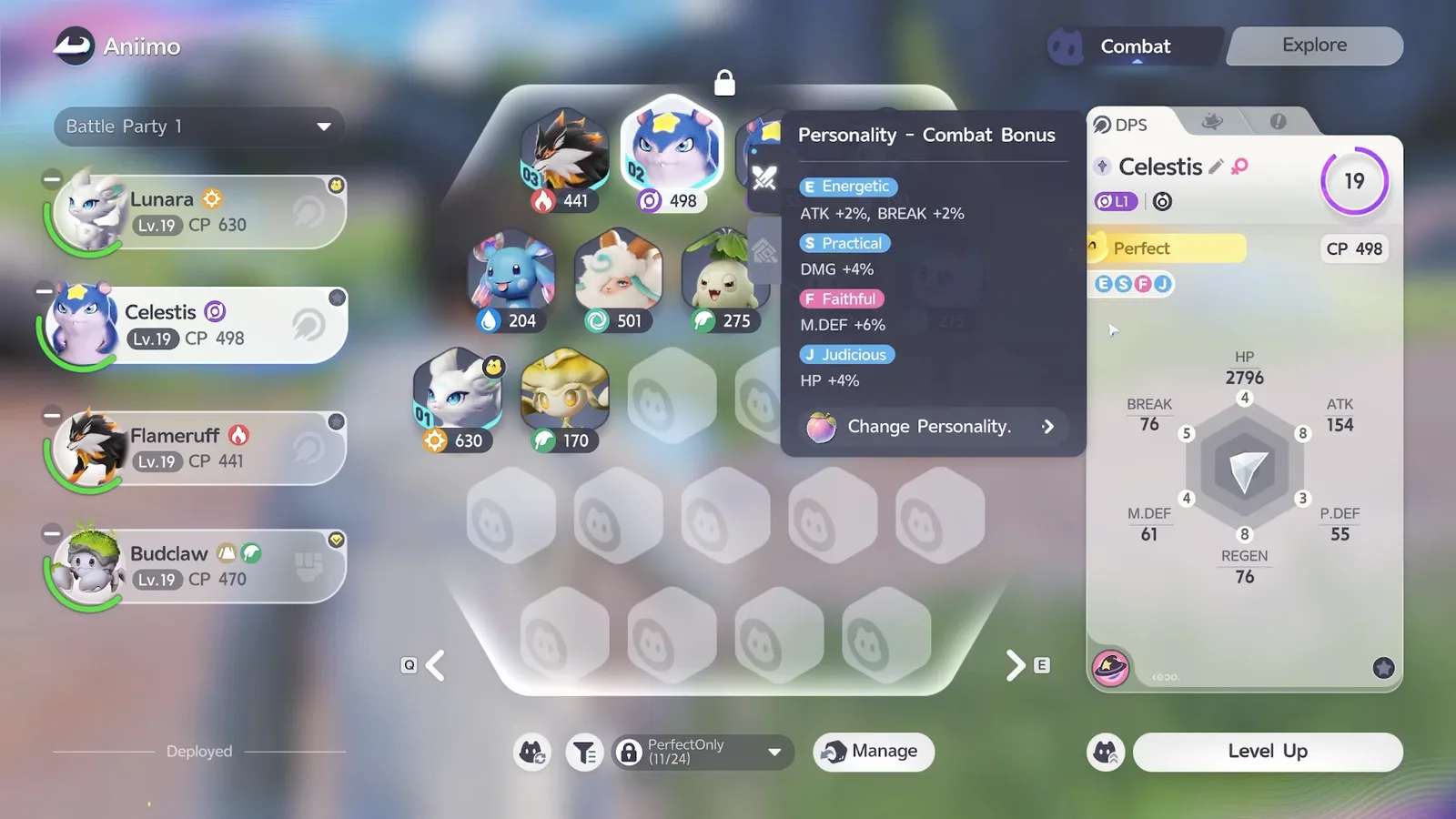
At the bottom of that panel is a Change Personality button. The item behind it is the Psyche Fruit, whose card reads Feed to an Aniimo to change its personality, bought from the shop. AniimoSync leaves it for a separate video, so here are the three rules the data files attach to it.
- It is random, not chosen. The tooltip reads Reverts to random personalities upon use. You are re-rolling, not picking.
- Some Aniimo cannot be changed at all, per the rest of that line: although some Aniimo personalities are fixed and cannot be altered.
- Nothing else touches it. Two separate tips say evolution and levelling both leave a personality exactly as it was.
What are element affinity traits?
A separate band of six traits, each with three tiers, sitting on top of Potential and personality. AniimoSync puts the full chart on screen, and it matches the tier text in the data files exactly.
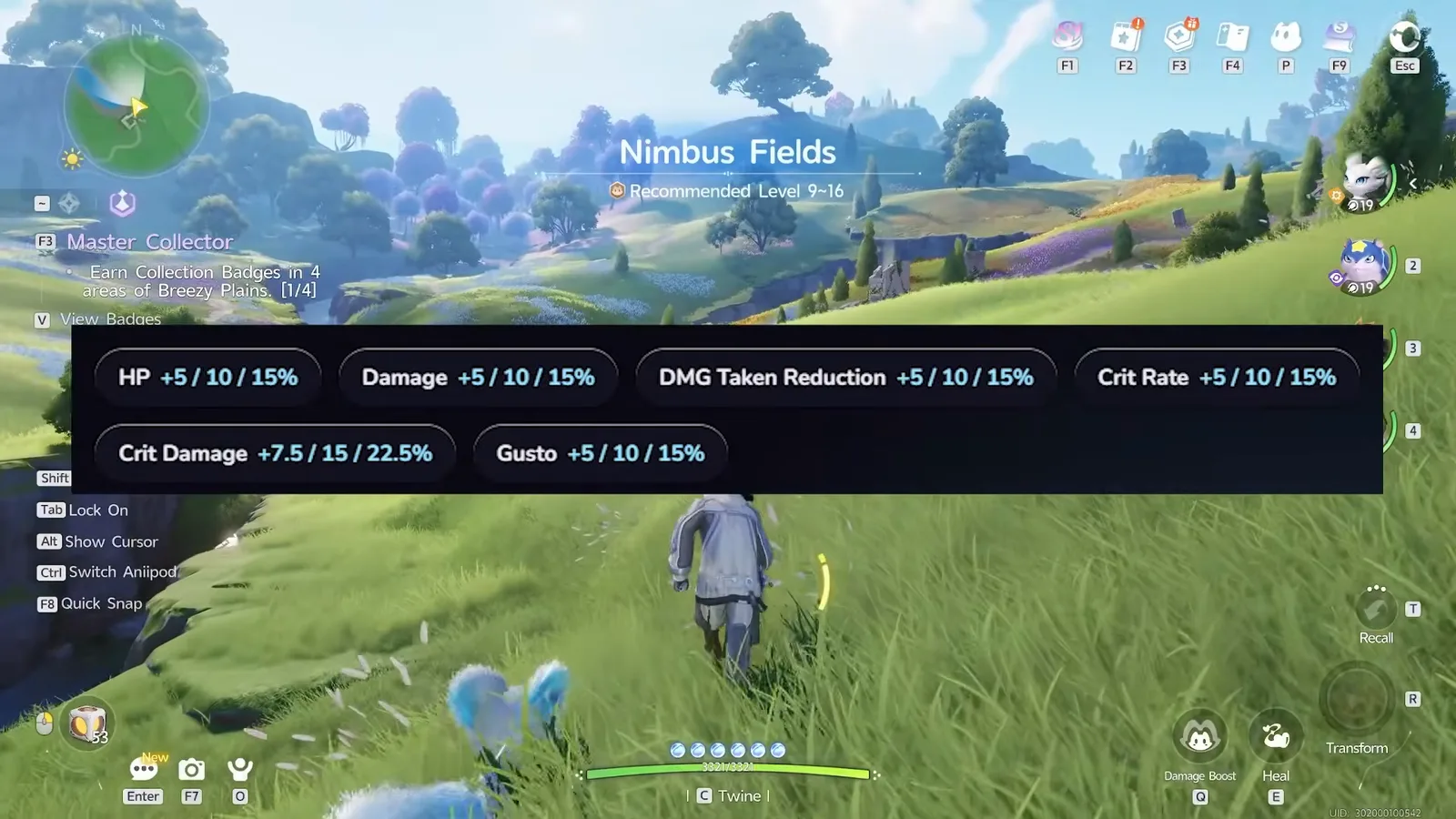
| Trait | Tier 1 | Tier 2 | Tier 3 |
|---|---|---|---|
| HP | +5% | +10% | +15% |
| Damage | +5% | +10% | +15% |
| DMG Taken Reduction | +5% | +10% | +15% |
| Crit Rate | +5% | +10% | +15% |
| Crit Damage | +7.5% | +15% | +22.5% |
| Gusto | +5% | +10% | +15% |
One honest caveat. The percentages above are the description strings the game prints on those rows, and they match AniimoSync’s chart, but the attribute values stored beside them in the same table read 0.03, 0.06 and 0.10 and are attached to element damage types. Treat the percentages as what the game displays rather than a verified multiplier. The structure, six traits at three tiers each, is the solid part.
Innate and acquired Potential: what can you still fix?
Innate Potential is rolled when the Aniimo is caught. Acquired Potential is raised afterwards, so a mediocre catch is never a total dead end. AniimoSync says exactly this at the end of the video, and the tables back all four of the routes below.
| Route | What it does |
|---|---|
| Capability Awakening | Spends Star Dust to raise acquired Potential. The tip reads: “the higher the Potential, the greater the attribute gains.” An achievement asks for 20 awakenings on one Aniimo, matching the 20-point per-stat ceiling. |
| Capafruit | “Use on an Aniimo to grant +1 Innate Potential to each of its six attributes.” Strictly one per Aniimo, ever. Twenty Capaseeds exchange for one at an outpost vendor. |
| Inheritance | Moves your investment onto a better copy. “All progress including level, resonance and capability will carry over, with excess materials returned in full.” It only runs from a developed Aniimo to a less developed one, and only within the same family. |
| Breeding | “You can select up to 4 innate potentials and 1 trait from the parents to produce the offspring egg.” Two parents of the same family and opposite sex. |
Inheritance is the one that answers the anxiety in the video’s title. Investing in an Elite while you hunt for a Perfect is not wasted, because the level, resonance stage, star rank, Capability Awakening and even the Capafruit all transfer when the better copy turns up. Eggs are the other lever: the Promise Egg system and our egg page both cover hatches guaranteed to be Elite or higher.
What should a beginner actually invest in?
Catch volume first, materials last. There is no way to read Potential before a catch, so the only thing that improves your odds is catching more. At 0.8% per wild catch, a Perfect is a hundred-odd catches away on average, which sounds grim until you remember that you will catch that many just playing the story.
A practical order for the first week:
- Catch four or five of anything you like the look of, then report the lot at once.
- Set the Release toggles before you press Next. Common and Good on is the sane default. Leave Elite off until you know what you want.
- Build a working squad out of whatever you have. Coverage beats grades early: a DPS, a BREAK unit and something that heals. Our team builder sorts the roster you actually own, and our new player guide covers the rest of day one.
- Spend Star Dust only on a Perfect, or on an Elite you are certain about.
- Take the free guaranteed rolls, such as the free Prismana and the egg on the Companion Handbook track.
The last word belongs to AniimoSync, because it is the correct one: do not go crazy about the stats. A Common Emberpup will clear every piece of story content in the game. Potential is for the day you decide to optimise, not the day you start.