Beginner · 12 min
Aniimo Beginner Guide: What to Expect When You First Start
The capture loop, Twining, Lumin to Nova evolution, Potential grades and Homeland: the systems that decide your first ten hours, and the four mistakes almost every new player makes.

Aniimo is a free-to-play, open-world creature-collection action RPG set on the continent of Idyll. You play a Pathfinder: you catch creatures, you bond with them, and (this is the part that makes it different) you become them.
If you are coming from Palworld, Pokémon or a mainstream gacha, some of the vocabulary will look familiar and some of it will not. This guide walks the systems in the order you will meet them, and flags the four decisions that quietly matter more than they look like they should.
What kind of game this is
Three framings, all true at once:
- An open-world action RPG. Real-time combat, traversal, biomes, weather, day/night. Idyll is a continuous world, not a menu of stages.
- A creature collector. Capture is done in the field with Aniipods. The index you are filling is the Aniilog, and it is bigger than the species count suggests because 57 lines have regional forms with their own elements and habitats.
- A gacha. Monetised, but weighted toward quality rather than access: Potential grades, Prismana variants and eggs, rather than locking creatures behind a banner.
The practical consequence: you cannot shortcut the world. Your account power comes from playing in the world under the right conditions, not only from pulling.
The capture loop
Catching an Aniimo is not a menu action. You study the creature’s behaviour, wait for the right moment, and time an Aniipod throw. Different species behave differently, and the environment is part of the equation.
Spawns respond to three axes that all move independently:
- Biome: forest, coastal, deep-sea, underground and so on.
- Weather: including confirmed interactions, such as rain weakening Fire abilities.
- Time of day: eight species in the launch client spawn only at night, and they are not all Dark. The full night list is below.
This is why "where do I find X" is rarely a one-line answer in Aniimo, and why our Aniilog lists element and role prominently alongside every published habitat. For the exact pin rather than the region, our interactive map carries 3,958 markers across Idyll and 25 in Astra, chests, eggs, Aniipods and Lumin Amber included.
The day and night cycle: what only exists after dark
Aniimo runs a day and night cycle, and night is not a lighting change: it is a spawn condition the launch client attaches to named entries. The official Beta Survival Handbook states it as "Day/Night & Weather Systems: Nocturnal Aniimo emerges after dark; rain weakens fire abilities", and the launch build carries it out with eight species that appear only at night, nine Nighttime Form entries, and five daily investigation targets that have to be caught after dark.
The consequence for a new Pathfinder is blunt. If you only ever play in daylight you are not catching these creatures late, you are not catching them at all, and two of the four night lines are role slots this guide tells you to fill early: the launch client's night-only Support line and its night-only Regen line both sit behind the cycle.
How to change the time of day in Aniimo
Open the game menu, press the Day and Night icon, and pick one of four time periods: Early morning, Noon, Dusk or Nighttime. Those are the launch client's own words: "Day and Night" is the label on the menu entry, the panel it opens tells you "Currently in the [period] time period", and choosing a different one asks "Are you sure you want to jump time forward to [period]?" before the world changes around you. Pick the period you are already in and nothing happens: the client just answers "Current time period".
The control is not there in your first hour. The client keeps it hidden and its own unlock line reads "Complete required story to unlock"; three separate quest entries in the same build put it in the journal as "Progress through Story Quests to unlock the day/night Switch feature", and all three wait on one quest. That quest's objective is "Stay at the elder's house for the night", and it sits inside Ceremony Preparations, the second section of the Journey to Bloomville chapter and the eighth section of the main story. Stay the night at the elder's house and the icon appears; before that, night only arrives when the clock brings it.
One restriction outlives the unlock: you can only change the time in your own world. Try it while you are visiting someone else's and the client answers "This feature cannot be used while you are in another player's world", so a co-op night hunt runs on the host's clock, not yours. The four options are fixed windows on the in-game clock rather than a free choice of hour, and Nighttime is much the longest of them:
| Menu option | In-game clock |
|---|---|
| Early morning | 06:00 to 08:00 |
| Noon | 08:00 to 17:00 |
| Dusk | 17:00 to 20:00 |
| Nighttime | 20:00 to 06:00 |
Ten of the twenty-four in-game hours are night, which is why the creatures below are missable rather than rare: the window is wide, and until you unlock the switch you only reach it by being at the keyboard when it comes round.
These are the eight Aniimo whose field entry in the launch client lists Nighttime as a spawn condition, with the spawn points the game's own data files record for each:
| Aniimo | Element | Role | Stage | Spawn points recorded | Also needs |
|---|---|---|---|---|---|
| Sparki | Fire | Regen | Lumin | 68: Nimbus Fields 31, Blitzwood 27, Beast Fang Ridge 10 | Nothing |
| Flamerion | Fire | Regen | Nova | 3: Beast Fang Ridge | Catching 15 Sparkis in a row |
| Bulbly | Lightning | Support | Lumin | 65: Tideblossom Coast | Nothing |
| Veilfloat | Lightning | Support | Gamma | 8: Tideblossom Coast | Nothing |
| Luminelle | Lightning | Support | Nova | 1: Tideblossom Coast | Nothing |
| Wisptis | Dark | DPS | Lumin | 47: Berylline Vale | Nothing |
| Ignitis | Dark | DPS | Nova | 3: Berylline Vale | Nothing |
| Pomawk | Grass | Break | Nova | 2: Rosetower Woods | Completing the Pomegg Party |
Read the element column before you accept the usual advice that night is where the Dark creatures live. Two of the eight are Dark. Three are Lightning, two are Fire and one is Grass, and the whole of the Bulbly line, the launch client's night-only Support line, is Lightning. Sparki is the one to prioritise: it is a Lumin-stage Regen unit with 68 recorded spawn points across three regions, which is the sustain slot the squad templates below ask for, and 31 of those points are in Nimbus Fields, the region the early game starts you in.
Night also produces its own catalogue entries. Nine launch entries are Nighttime Forms, separate Aniilog pages with their own artwork and, on six of the nine, a Dark element layered on top of the base one:
| Nighttime Form | Stage | Basic element | Nighttime element | Role | Spawn points recorded |
|---|---|---|---|---|---|
| Bonesky | Lumin | Ice | Dark and Ice | DPS | 12: Rosetower Woods |
| Fenrier | Gamma | Ice | Dark and Ice | DPS | 3: Rosetower Woods |
| Glynsera | Nova | Ice | Dark and Ice | DPS | 1: Rosetower Woods |
| Flutternym | Lumin | Wind | Dark and Wind | Heal | 45: Sea of Flowers |
| Gracewing | Nova | Wind | Dark and Wind | Heal | None recorded |
| Piopiota | Nova | Water | Dark and Water | Support | None recorded |
| Susuta | Lumin | Water | Water | Break | 25: Echoback Landing |
| Popota | Gamma | Water | Water | Break | None recorded |
| Panpanta | Nova | Water | Water | Break | None recorded |
An element change is not cosmetic in a game where a favourable matchup multiplies damage by 1.6× and a double weakness reaches 2.56×, so a Nighttime Form is functionally a different unit from the basic one, and the element chart settles which. The forms with no recorded spawn points are the later stages: you evolve into those rather than find them, and our complete guide to Aniimo forms covers the evolution window each one needs.
The cycle reaches the daily loop as well. Five Tracking Point investigation targets in the launch client carry the instruction "Catch the target Aniimo at night to complete the investigation and earn points", and they are Sparki, Susuta, Panpanta, Bonesky and Flutternym, which is the night list above turning up again as daily objectives. Our interactive map carries the Tracking Point layer if you want the pins.
Every species, form, spawn count and condition above is read from the launch client's own tables, build 1.0.0.7, and so are the menu labels and the unlock quest at the top of this section.
Twining: the signature mechanic
Twining is the mechanic the whole game is built around. Once you have a Twine bond with a captured Aniimo, you do not just command it from a distance. You take its form. You see through its eyes and wield its abilities directly.
Combat therefore has two registers:
- Command mode: you direct your Aniimo, positioning and playing to their kits.
- Twine mode: you become one of them and use its movement and combos yourself.
Beginners tend to treat Twining as a damage button. It is more useful to think of it as answering a question: what do I need right now?
- Traversal Twine: mobility first, damage second. Wind-element Aniimo carry most of the traversal value in the roster.
- Puzzle Twine: transform, read the environmental feedback, swap again. Idyll’s puzzles frequently expect a specific elemental interaction.
- Combat Twine: enter with an exit plan and a second role ready. Twining into a DPS with no way back to a Heal unit is how early deaths happen.
The habit worth building from hour one: before you transform, name the outcome you want: cross terrain, trigger an interaction, dodge pressure, or convert an elemental opening.
Roles and elements
Every Aniimo has one of five combat roles (DPS, Break, Support, Heal, Regen) and one of nine elements: Fire, Water, Grass, Lightning, Earth, Wind, Dark, Ice and Light.
Roles matter more than elements early on. A squad without a Break unit cannot reliably create stagger windows, and a squad without healing cannot hold a longer fight regardless of how much damage it does. The full nine-element matrix is in the launch client and charted on our element chart: a favourable matchup multiplies damage by 1.6×, an unfavourable one by 0.625×, and a dual-element form multiplies its defensive matchups together, which is how a double weakness reaches 2.56×.
Five squad templates
Aniimo combat resolves around stagger: Break units strip enemy poise, that creates a damage window, and DPS units convert it. A squad missing the first half of that sentence does not deal less damage. It deals its damage into a target that is still defending itself. So every template below is built on combat roles rather than named units: what each slot has to accomplish stays true whichever Aniimo you actually caught.
- The Default: Break → DPS → Heal. The composition that works before you know anything: Break strips poise and holds the line, DPS is your Twine target once the stagger lands, Heal covers the mistimed holds. Use it for exploration and first clears; the trade-off is a low ceiling.
- Double Break: Break → Break → DPS. Two staggers with different elements for enemies whose poise one unit cannot open, and a much longer window for the single damage slot. The safest opener for heavy world bosses and Egg Heist. No dedicated sustain, so the second Break unit has to be tanky enough to substitute.
- Attrition: Regen → Break → DPS. Regen over Heal: constant over-time restoration for long solo sessions and farming loops. Regen cannot save you from a burst mechanic. Bring Heal instead if you are getting one-shot.
- Amplified: Support → DPS → Break. Support amplifies into the window Break creates, feeding one heavily Resonance-trained DPS. The highest ceiling and the least forgiving: no sustain at all, for content you have already cleared and want to clear faster.
- Traversal: Support (Wind) → DPS → Regen. Not a combat squad: a Wind unit for mobility, a DPS for the unavoidable fights, Regen to skip supply stops. The one you actually run while filling the Aniilog or chasing Prismana weather. Swap before a boss.
The checklist that falls out of those five: one Break unit, non-negotiable early; one DPS you are prepared to Resonance-train rather than three you are not; one sustain slot: Heal for burst danger, Regen for long fights; and a Wind unit somewhere for traversal, even as a swap. Treat elements as the tiebreaker between two role-correct options, not the primary axis: 1.6× on a unit that cannot create a damage window is still nothing. The element chart settles the tiebreaks, and the tier list shows where each candidate ranks.
Evolution: Lumin → Gamma → Nova
Aniimo evolve through up to three stages: Lumin (base), Gamma (mid) and Nova (final). Not every line has all three: plenty go straight from Lumin to Nova, and several confirmed creatures only exist at Nova stage in the current data.
Crucially, evolution is multi-branch. Some lines fork based on the material you feed them, and the branches can land on different elements entirely. Pebbling is the clearest documented case: it can become the Earth-element Geodeback line, or the Fire-element Lavazar line.
Beginner advice: do not rush an evolution just because the material is available. A branch is a decision, and the branching evolution material in the pre-order packs exists precisely because those materials are not trivially farmed.
Potential, traits and Resonance
This is the layer most new players discover twenty hours late.
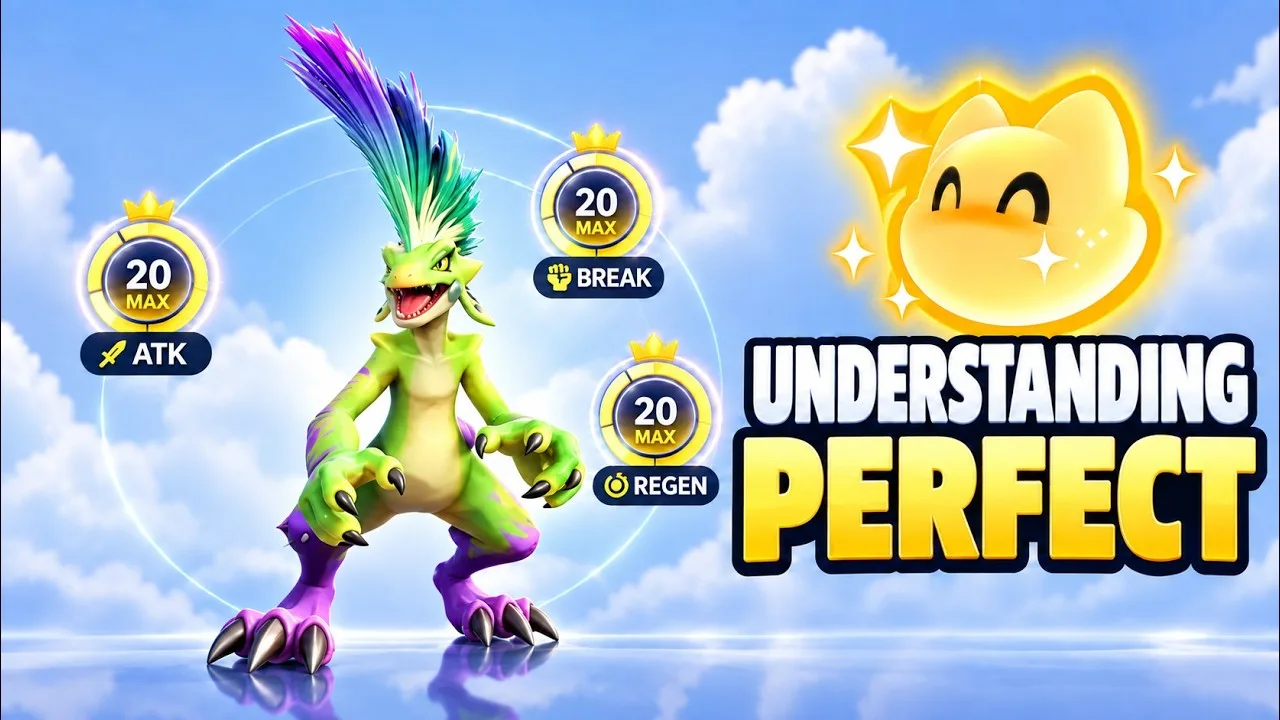
- Potential: an appraised quality grade running from Common up to Perfect. Two identical species are not equal.
- Traits: four MBTI-style personality axes, each pushing specific stats.
- Resonance training: a per-creature progression track from level 20 to 60, consuming three tiers of Astranites (Basic, Standard, Advanced).
The interaction that matters: Astranites are finite, and Resonance is per-creature. Pouring Advanced Astranites into a Common-Potential creature because it was the first Nova you caught is the single most expensive beginner mistake in the game. Appraise first, invest second.
Pawprint publishes no numeric table for the Potential bands themselves, so anywhere you see hard per-band figures, treat them as somebody’s measurement rather than a disclosure. What the launch build does guarantee is the top of the scale: a Sparkling Cube now produces Perfect Potential as well as the Sparkling variant, and Umbral Aniimo always roll Perfect.
Homeland and the Hatchinator
You get a personal base: an RV that anchors a customisable Homeland where you plant crops, gather resources and build automation. It is also where the Hatchinator lives.
Eggs are the second acquisition route alongside field capture, and they run on real-time incubation timers. The Homeland Hatchinator has a Caress function that instantly completes an egg’s timer. A single Caress has been observed completing a ten-minute incubation, with a documented limit of 20 uses (the refresh cadence is unconfirmed, likely daily). When an egg is ready you interact with the Hatchinator and follow the prompt to pet the egg, and the creature’s role, element, stage and quality are revealed in sequence.
Eggs are the second acquisition route alongside field capture, and the Hatchinator is where they turn into creatures, so an idle Hatchinator is wasted real time.
Your first ten hours, in order
- Link your accounts before the tutorial. See the Pre-Order Q&A.
- Catch broadly, not deeply. Aniilog entries are progression. Grab everything you see, even duplicates: Potential varies per catch.
- Get one Break unit and one Heal or Regen unit early. Your first wall will be a stagger check or a sustain check, not a damage check.
- Set up the Homeland as soon as it unlocks. Incubation runs on real time: an idle Hatchinator is wasted hours.
- Start Twining deliberately. Use a Wind unit for traversal and keep a second role ready before you commit in a fight.
- Do not spend Advanced Astranites yet. Wait until you have appraised enough creatures to know what a good Potential roll looks like.
Four mistakes to avoid
- Skipping the account link. Costs you your save, or a support ticket.
- Investing Resonance materials into your first Nova. Costs you the finite resource that makes your eventual best creature good.
- Evolving a branching line on autopilot. Costs you the branch you actually wanted.
- Playing at one time of day. Costs you access to nocturnal Dark spawns and to Prismana weather windows entirely.
Next steps: browse every confirmed creature in the Aniilog, or see who ranks where in the tier list.